OBC 2006 › Division B
7.2.
Version 0 — in force 31 December 2006
This looks wrong
Tell us what is wrong and we will verify & correct our mapping.
- Edition
- OBC_2006
- Division
- B
- Provision
- 7.2.
- Version
- v0
(1) This Regulation comes into force on December 31, 2006.
Read directly from the regulation's own commencement section.
O. Reg. 350/06 · commencement 2.2.1.1(1)
This version stayed in force until the next edition replaced it. What follows is that edition’s base regulation’s commencement — the takeover that ended this one.
(1) Subject to Sentences (2) and (3), this Regulation comes into force on January 1, 2014.
Read directly from the regulation's own commencement section.
O. Reg. 332/12 · commencement 4.4.1.1(1)
This looks wrong
Tell us what is wrong and we will verify & correct our mapping.
- Edition
- OBC_2006
- Division
- B
- Provision
- 7.2.
- Version
- v0
(1) This Regulation comes into force on December 31, 2006.
Read directly from the regulation's own commencement section.
O. Reg. 350/06 · commencement 2.2.1.1(1)
This version stayed in force until the next edition replaced it. What follows is that edition’s base regulation’s commencement — the takeover that ended this one.
(1) Subject to Sentences (2) and (3), this Regulation comes into force on January 1, 2014.
Read directly from the regulation's own commencement section.
O. Reg. 332/12 · commencement 4.4.1.1(1)
Provenance
OBC 1997 · continues from 7.2. — Pro
Base · O. Reg. 350/06 · ext← current
Original — base regulation
OBC 2012 · continues as 7.2. — Pro
7.2. — Materials and Equipment
Content not available for this version.
7.2.1. — General
Content not available for this version.
7.2.1.1. — Exposure of Materials
(1) Where unusual conditions exist such as excessively corrosive soil or water, only materials suited for use in such locations shall be used.
(2) Materials and equipment used in a drainage system where excessively corrosive wastes are present shall be suitable for the purpose.
Text · e-Laws consolidated snapshot
7.2.1.2. — Restrictions on Re-Use
(1) Used materials and equipment, including fixtures, shall not be reused unless they meet the requirements of this Part for new materials and equipment and are otherwise satisfactory for their intended use.
(2) Materials and equipment that have been used for a purpose other than the distribution of potable water shall not be subsequently used in a potable water system.
Text · e-Laws consolidated snapshot
7.2.1.3. — Identification and Certification
(1) Every length of pipe and every fitting shall have cast, stamped or indelibly marked on it the maker's name or mark and the weight or class or quality of the product, or it shall be marked in accordance with the relevant standard, and such markings shall be visible after installation.
(2) Where a component of a plumbing system is required by this Code to comply with a standard and the compliance is not certified by a testing agency accredited by the Standards Council of Canada for the testing of the component in question and, when an inspector requests proof of the compliance, proof of compliance shall be produced by the person proposing to install or have installed the component, and without such proof the component shall not be installed as a permanent part of any plumbing system.
(3) The lack of certification markings on a product or plumbing component shall be regarded as proof, in the absence of evidence to the contrary that no certification exists.
(4) If a component of a plumbing system is required to be certified to a standard, the certification shall be made by a testing agency accredited for that purpose by the Standards Council of Canada.
Text · e-Laws consolidated snapshot
7.2.1.4. — Pipe or Piping
(1) Where the term pipe or piping and fittings is used, it shall also apply to tube or tubing and fittings unless otherwise stated.
Text · e-Laws consolidated snapshot
7.2.1.5. — Withstanding Pressure
(1) Piping, fittings and joints used in pressure sewer, forcemain or sump pump discharge applications shall be capable of withstanding at least one and one-half times the maximum potential pressure.
Text · e-Laws consolidated snapshot
7.2.2. — Fixtures
Content not available for this version.
7.2.2.1. — Surface Requirements
(1) Except for the area designed to be slip proof in such fixtures, every exposed area of a fixture shall have a smooth, hard corrosion-resistant surface that is free from flaws and blemishes that may interfere with cleaning.
Text · e-Laws consolidated snapshot
7.2.2.2. — Conformance to Standards
(1) Every water closet and urinal shall conform to the requirements in Article 7.6.4.2.v1
(2) Every vitreous china fixture shall conform to CAN/CSA-B45.1, “Ceramic Plumbing Fixtures”.
(3) Every enamelled cast iron fixture shall conform to CAN/CSA-B45.2, “Enamelled Cast Iron Plumbing Fixtures”.
(4) Every porcelain enamelled steel fixture shall conform to CAN/CSA-B45.3, “Porcelain-Enamelled Steel Plumbing Fixtures”.
(5) Every stainless steel fixture shall conform to CAN/CSA-B45.4, “Stainless Steel Plumbing Fixtures”.
(6) Every plastic fixture shall conform to CAN/CSA-B45.5, “Plastic Plumbing Fixtures”.
(7) Every hydromassage bathtub shall conform to CAN/CSA-B45.10, “Hydromassage Bathtubs”.
(8) Every macerating toilet system for single bathrooms shall conform to CAN/CSA-B45.9, “Macerating Systems and Related Components”.
Text · e-Laws consolidated snapshot
7.2.2.3. — Showers
(1) Every shower receptor shall be constructed and arranged so that water cannot leak through the walls or floor.
(2) Not more than 6 shower heads shall be served by a single shower drain.
(3) Where two or more shower heads are served by a shower drain, the floor shall be sloped and the drain located so that water from one head cannot flow over the area that serves another head.
(4) Except for column showers, when a battery of shower heads is installed, the horizontal distance between two adjacent shower heads shall be at least 750 mm.
Text · e-Laws consolidated snapshot
7.2.2.4. — Concealed Overflows
(1) A dishwashing sink and a food preparation sink shall not have concealed overflows.
Text · e-Laws consolidated snapshot
7.2.2.5. — Water Closets in Public Washrooms
(1) Except for Eastern-Style toilets, where a water closet is installed in a washroom for public use it shall be of the elongated type and provided with a seat of the open front type.
Text · e-Laws consolidated snapshot
7.2.2.6. — Lavatories
(1) A lavatory that does not have an overflow shall be equipped with a centre outlet waste fitting.
Text · e-Laws consolidated snapshot
7.2.2.7. — Trough Urinals
(1) No trough urinal shall be used as part of a plumbing system.
Text · e-Laws consolidated snapshot
7.2.3. — Traps and Interceptors
Content not available for this version.
7.2.3.1. — Traps
(1) Except as provided for in Sentence (2), every trap shall,
(a) have a trap seal depth of at least 38 mm,
(b) be so designed that failure of the seal walls will cause exterior leakage, and
(c) have a water seal that does not depend on the action of moving parts.
(2) The trap seal depth on fixtures draining to an acid waste system shall be a minimum of 50 mm.
(3) Every trap that serves a lavatory, a sink or a laundry tray shall,
(a) be provided with a cleanout plug of a minimum ¾ in. size located at the lowest point of the trap and of the same material as the trap, except that a cast iron trap shall be provided with a brass cleanout plug, or
(b) be designed so that part of the trap can be removed for cleaning purposes.
(4) A bell trap or an S-trap shall not be installed in a drainage system.
(5) A drum trap shall not be installed in a drainage system.
(6) Except as permitted in Sentence (7), no bottle trap shall be used in a plumbing system.
(7) A bottle trap may be used on a laboratory sink or other fixture equipped with corrosion resistant fittings.
(8) No running trap shall be installed in a plumbing system unless an accessible handhole is provided for cleaning of the trap, and where the trap is too small to accommodate a handhole, a cleanout shall be provided.
Text · e-Laws consolidated snapshot
7.2.3.2. — Interceptors
(1) Every interceptor shall be designed so that it can be readily cleaned.
(2) Every grease interceptor shall be designed so that it does not become air bound.
Text · e-Laws consolidated snapshot
7.2.3.3. — Tubular Traps
(1) Tubular metal or plastic traps that conform to CAN/CSA-B125, “Plumbing Fittings” shall be used in accessible locations.
Text · e-Laws consolidated snapshot
7.2.4. — Pipe Fittings
Content not available for this version.
7.2.4.1. — T and Cross Fittings
(1) A T fitting shall not be used in a drainage system except to connect a vent pipe.
(2) A cross fitting shall not be used in a drainage system.
Text · e-Laws consolidated snapshot
7.2.4.2. — Sanitary T Fittings
(1) A double sanitary T fitting shall not be used to connect the fixture drains of two urinals where no cleanout fitting is provided above the connection.
(2) No pipe fitting, joint or connection that would tend to intercept solids or reduce the flow through a pipe by more than 10 percent shall be used in a plumbing system.
Editor's note
In Sentence 7.2.4.2.(2), the as-filed O. Reg. 350/06 writes 'percent' (one word); this map reproduces the source as filed. The e-Laws consolidation renders it as 'per cent' (two words), the spelling used elsewhere in the regulation. This spelling difference was not enacted by an amending regulation.
7.2.4.3. — 90° Elbows
(1) Except as permitted in Sentences (2) and (3), 90° elbows of 4 in. size or less that have a centre-line radius that is less than the size of the pipe shall not be used to join two soil or waste pipes.
(2) 90° elbows of 4 in. size or less in sanitary drainage systems may be used,
(a) to change the direction of piping from horizontal to vertical, in the direction of flow,
(b) where a trap arm enters a wall, or
(c) to connect trap arms as permitted by Sentence 7.5.6.3.(2)v1.
(3) A 90° elbow that is part of the pre-engineered wastewater heat recovery system is permitted to have a centre-line radius that is less than the size of the pipe.
Text · e-Laws consolidated snapshot
7.2.4.4. — Fittings Restricted in Use
(1) No double Y, double TY, double T or double waste fitting shall be installed in a nominally horizontal soil or waste pipe.
Text · e-Laws consolidated snapshot
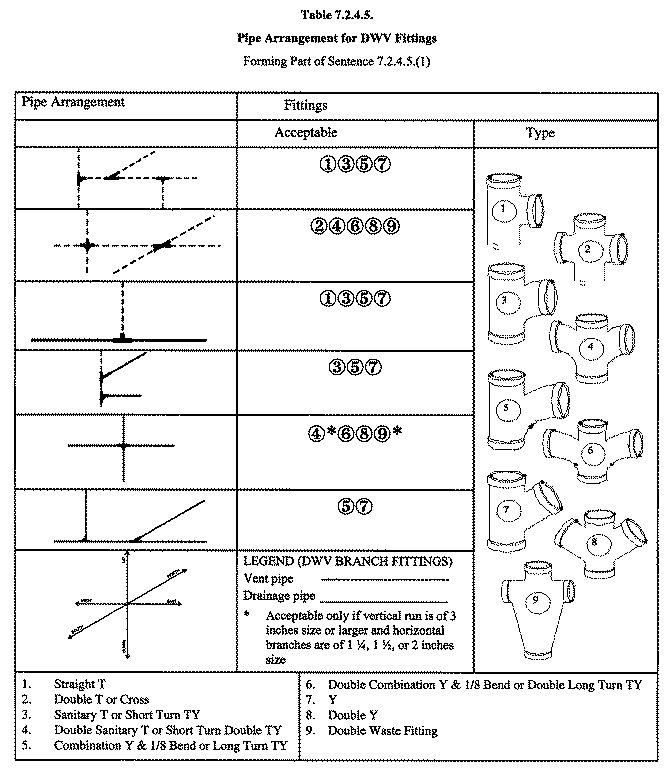
7.2.4.5. — Assembled Pipe or Tubing
(1) Pipe or tubing assembled to comprise a standard drain waste and venting system shall be connected with drain, waste and vent fittings in conformance with Table 7.2.4.5.
Text · e-Laws consolidated snapshot
7.2.5. — Non-Metallic Pipe and Fittings
Content not available for this version.
7.2.5.1. — Asbestos-Cement Drainage Pipe and Fittings
(1) Except as provided in Sentence (2), asbestos-cement pipe and its fittings for use in a drain, waste or vent system shall conform to,
(a) CAN/CGSB-34.22, “Asbestos-Cement Drain Pipe”, or
(b) CSA B127.1, “Asbestos Cement Drain, Waste and Vent Fittings”.
(2) Asbestos-cement pipe and fittings used underground either outside a building or under a building shall conform to Sentence (1) or to,
(a) CAN/CGSB-34.9, “Asbestos-Cement Sewer Pipe”,
(b) CAN/CGSB-34.23, “Asbestos-Cement House Connection Sewer Pipe”, or
(c) CSA B127.2, “Components for Use in Asbestos-Cement Building Sewer Systems”.
Text · e-Laws consolidated snapshot
7.2.5.2. — Reserved.
Content not available for this version.
Editor's note
As filed in O. Reg. 350/06, the heading of this article reads 'Reserved.' with a closing period. The consolidated e-Laws text renders it without the period ('Reserved'); the as-filed heading is retained here.
7.2.5.3. — Concrete Pipe and Fittings
(1) Concrete pipe shall conform to CSA A257 Series, “Standards for Circular Concrete Pipe and Manholes”.
(2) Joints with external elastomeric gaskets shall be made with corrosion resistant external band type flexible mechanical couplings that conform to CAN/CSA-B602, “Mechanical Couplings for Drain, Waste, and Vent Pipe and Sewer Pipe”.
(3) Concrete fittings field fabricated from lengths of pipe shall not be used.
(4) Concrete pipe shall not be used above ground inside a building.
(5) Precast reinforced circular concrete manhole sections, catch basins and fittings shall conform to CSA A257.4, “Precast Reinforced Circular Concrete Manhole Sections, Catch Basins, and Fittings”.
Text · e-Laws consolidated snapshot
7.2.5.4. — Vitrified Clay Pipe and Fittings
(1) Vitrified clay pipe and fittings shall be certified to CSA A60.1-M, “Vitrified Clay Pipe”.
(2) Couplings and joints for vitrified clay pipe shall be certified to CSA A60.3-M, “Vitrified Clay Pipe Joints”.
(3) Vitrified clay pipe and fittings shall not be used except for an underground part of a drainage system.
Text · e-Laws consolidated snapshot
7.2.5.5. — Polyethylene Pipe and Fittings
(1) Polyethylene water pipe, tubing and fittings shall be certified to Series 160 of CAN/CSA-B137.1, “Polyethylene Pipe, Tubing and Fittings for Cold Water Pressure Services”.
(2) Except as permitted in Sentence 7.2.5.7.(1)v1, polyethylene water pipe shall not be used except for a water service pipe.
(3) Butt fusion fittings for polyethylene pipe shall conform to ASTM D3261, “Butt Heat Fusion Polyethylene (PE) Plastic Fittings for Polyethylene (PE) Plastic Pipe and Tubing”.
Text · e-Laws consolidated snapshot
7.2.5.6. — Polyethylene Pipe Used Underground
(1) Polyethylene pipe used underground in a drainage system for rehabilitation of existing systems using trenchless technology shall conform to ASTM F714, “Polyethylene (PE) Plastic Pipe (SDR-PR) Based on Outside Diameter” and shall be HDPE 3408, SDR 17 or heavier.
Text · e-Laws consolidated snapshot
7.2.5.7. — Crosslinked Polyethylene Pipe and Fittings
(1) Cross-linked polyethylene pipe and its associated fittings used in hot and cold potable water systems shall be certified to CAN/CSA-B137.5, “Cross-linked Polyethylene (PEX) Tubing Systems for Pressure Applications”.
Text · e-Laws consolidated snapshot
7.2.5.8. — PVC Pipe and Fittings
(1) PVC water pipe, fittings and solvent cement shall be certified to CAN/CSA-B137.3, “Rigid Polyvinyl Chloride (PVC) Pipe for Pressure Applications” or CAN/CSA-B137.2, “PVC Injection-Moulded Gasketed Fittings for Pressure Applications”, and have a minimum pressure rating of 1 100 kPa.
(2) PVC water pipe and fittings in Sentence (1) shall not be used in a hot water system.
Text · e-Laws consolidated snapshot
7.2.5.9. — CPVC Pipe, Fittings and Solvent Cements
(1) CPVC hot and cold water pipe, fittings and solvent cements shall be certified to CSA B137.6, “CPVC Pipe, Tubing and Fittings for Hot and Cold Water Distribution Systems”.
(2) The design temperature and design pressure of a CPVC piping system shall conform to CSA B137.6, “CPVC Pipe, Tubing and Fittings for Hot and Cold Water Distribution Systems”.
Text · e-Laws consolidated snapshot
7.2.5.10. — Plastic Pipe, Fittings and Solvent Cement Used Underground
(1) Plastic pipe, fittings and solvent cement used underground outside a building or under a building in a drainage system shall be certified to,
(a) ASTM F628, “Acrylonitrile-Butadiene-Styrene (ABS) Schedule 40 Plastic Drain, Waste and Vent Pipe With a Cellular Core”.
(b) CAN/CSA-B181.1, “ABS Drain, Waste, and Vent Pipe and Pipe Fittings”,
(c) CAN/CSA-B181.2, “PVC Drain, Waste, and Vent Pipe and Pipe Fittings”,
(d) CAN/CSA-B182.1, “Plastic Drain and Sewer Pipe and Pipe Fittings”,
(e) CAN/CSA-B182.2, “PVC Sewer Pipe and Fittings, (PSM Type)”,
(f) CAN/CSA-B182.4, “Profile (Ribbed) PVC Sewer Pipe and Fittings”,
(g) CAN/CSA-B182.6, “Profile Polyethylene Sewer Pipe and Fittings”,
(h) CAN/CSA B182.7, “Multilayer PVC Sewer Pipe (PSM Type) Having Reprocessed-Recycled Content”,
(i) CAN/CSA-B137.2, “PVC Injection-Moulded Gasketed Fittings for Pressure Applications”, or
(j) CAN/CSA-B137.3, “Rigid Polyvinyl Chloride (PVC) Pipe for Pressure Applications”,
(2) Except as permitted in Clauses (i) and (j), plastic pipe used as described in Sentence (1) shall have a stiffness equal or greater than 320 kPa.
Text · e-Laws consolidated snapshot
7.2.5.11. — Transition Solvent Cement
(1) Solvent cement for transition joints shall conform to,
(a) CAN/CSA-B181.1, “ABS Drain, Waste and Vent Pipe and Pipe Fittings”, or
(b) CAN/CSA-B181.2, “PVC Drain, Waste and Vent Pipe and Pipe Fittings”.
(2) Transition solvent cement shall only be used for joining an ABS plumbing system to a PVC plumbing system.
Text · e-Laws consolidated snapshot
7.2.5.12. — Plastic Pipe, Fittings and Solvent Cement Used in Buildings
(1) Plastic pipe, fittings and solvent cement used inside or under a building in a sanitary drainage system or venting system shall be certified to,
(a) ASTM F628, “Acrylonitrile-Butadiene-Styrene (ABS) Schedule 40 Plastic Drain, Waste, and Vent Pipe With a Cellular Core”.
(b) CAN/CSA-B181.1, “ABS Drain, Waste, and Vent Pipe and Pipe Fittings”, or
(c) CAN/CSA-B181.2, “PVC Drain, Waste, and Vent Pipe and Pipe Fittings”.
(2) Plastic pipe, fittings and solvent cement used inside a building in a storm drainage system shall be certified to,
(a) ASTM F628, “Acrylonitrile-Butadiene-Styrene (ABS) Schedule 40 Plastic Drain, Waste, and Vent Pipe With a Cellular Core”.
(b) CAN/CSA-B181.1, “ABS Drain, Waste, and Vent Pipe and Pipe Fittings”,
(c) CAN/CSA-B181.2, “PVC Drain, Waste, and Vent Pipe and Pipe Fittings”,
(d) CAN/CSA-B182.1, “Plastic Drain and Sewer Pipe and Pipe Fittings”, or
(e) CAN/CSA-B182.2, “PVC Sewer Pipe and Fittings, (PSM Type)”.
(3) Plastic pipe used as described in Sentence (2) shall have a pipe stiffness equal or greater than 320 kPa.
(4) Requirements for combustible piping in relation to fire safety shall conform to Sentences 3.1.5.16.(1) and 9.10.9.6.(2) to (8) and Articles 3.1.9.4. and 9.10.9.7.
(5) Where noncombustible piping pierces a fire separation or a fire stop, the requirements for fire stopping of Subsection 3.1.9., Sentence 9.10.9.6.(1) and Article 9.10.16.4. shall apply.
Text · e-Laws consolidated snapshot
7.2.5.13. — Polyethylene/Aluminum/Polyethylene Composite Pipe and Fittings
(1) PE/AL/PE composite pipe and fittings used for potable water systems shall conform to CAN/CSA-B137.9, “Polyethylene/Aluminum/ Polyethylene Composite Pressure Pipe Systems”.
(2) PE/AL/PE pipe and fittings shall not be used in a hot water system.
Text · e-Laws consolidated snapshot
7.2.5.14. — Crosslinked Polyethylene/ Aluminum/ Polyethylene Composite Pipe and Fittings
(1) PEX/AL/PEX composite pipe and fittings used for potable water systems shall conform to CAN/CSA-B137.10, “Crosslinked Polyethylene/Aluminum/Crosslinked Polyethylene Composite Pressure Pipe Systems”.
Text · e-Laws consolidated snapshot
7.2.5.15. — Polypropylene Pipe and Fittings
(1) Polypropylene pipe and fittings used for hot and cold potable water systems shall conform to CAN/CSA-B137.11, “Polypropylene (PP-R) Pipe and Fittings for Pressure Applications”.
Text · e-Laws consolidated snapshot
7.2.6. — Ferrous Pipe and Fittings
Content not available for this version.
7.2.6.1. — Cast Iron Drainage and Vent Pipe and Fittings
(1) Drainage piping, vent piping and fittings made of cast iron shall be certified to CAN/CSA-B70, “Cast Iron Soil Pipe, Fittings and Means of Joining”.
(2) Cast iron soil pipe and fittings shall not be used in a water system.
Text · e-Laws consolidated snapshot
7.2.6.2. — Cast Iron Fittings for Asbestos-Cement Drainage Pipe
(1) Cast iron fittings designed for use with asbestos-cement pipe for drainage purposes shall conform to the applicable requirements of,
(a) CSA B127.1, “Asbestos Cement Drain, Waste and Vent Fittings”, or
(b) CSA B127.2-M, “Components for Use in Asbestos Cement Building Sewer Systems”.
Text · e-Laws consolidated snapshot
7.2.6.3. — Threaded Cast Iron Drainage Fittings
(1) Threaded cast iron drainage fittings shall conform to ANSI/ASME B16.12, “Cast-Iron Threaded Drainage Fittings”.
(2) Threaded cast iron drainage fittings shall not be used in a water system.
Text · e-Laws consolidated snapshot
7.2.6.4. — Cast Iron Water Pipe
(1) Cast iron water pipes shall conform to ANSI/AWWA C151/A21.51, “Ductile-Iron Pipe, Centrifugally Cast for Water”.
(2) Cement mortar lining for cast iron water pipes shall conform to ANSI/AWWA C104/A21.4, “Cement-Mortar Lining for Ductile-Iron Pipe and Fittings for Water”.
(3) Iron fittings for cast iron or ductile-iron water pipes shall conform to ANSI/AWWA C110/A21.10, “Ductile-Iron and Gray-Iron Fittings, 3-in. Through 48-in., (75 mm Through 1200 mm) for Water and Other Liquids”.
(4) Rubber gasket joints for cast iron and ductileiron pressure pipe for water piping shall conform to ANSI/AWWA C111/A21.11, “Rubber-Gasket Joints for Ductile-Iron Pressure Pipe and Fittings”.
Text · e-Laws consolidated snapshot
7.2.6.5. — Screwed Cast Iron Water Fittings
(1) Screwed cast iron water fittings shall conform to ANSI/ASME B16.4, “Gray Iron Threaded Fittings”.
(2) Screwed cast iron water fittings used in a water system shall be cement-mortar lined or galvanized.
(3) Screwed cast iron water fittings shall not be used in a drainage system.
Text · e-Laws consolidated snapshot
7.2.6.6. — Screwed Malleable Iron Water Fittings
(1) Screwed malleable iron water fittings shall conform to ANSI/ASME B16.3, “Malleable Iron Threaded Fittings”.
(2) Screwed malleable iron water fittings used in a water system shall be cement-mortar lined or galvanized.
(3) Screwed malleable iron water fittings shall not be used in a drainage system.
Text · e-Laws consolidated snapshot
7.2.6.7. — Steel Pipe
(1) Except as provided in Sentences (2) and (3), welded and seamless steel pipe shall not be used in a plumbing system.
(2) Galvanized steel pipe may be used in a drainage system or a venting system above ground inside a building.
(3) Galvanized steel pipe and fittings shall not be used in a water distribution system except,
(a) in buildings of industrial occupancy, or
(b) for the repair of existing galvanized steel piping systems.
(4) Galvanized steel pipe and fittings shall conform to ASTM A53/A53M, “Pipe, Steel, Black and Hot Dipped, Zinc-Coated Welded and Seamless”.
(5) Where galvanized steel pipe is used in a drainage system, it shall be used with drainage fittings.
(6) All steel pipe of 4 in. size and smaller shall be schedule 40 or heavier and fittings of less than 2 in. size shall be galvanized screw fittings.
Text · e-Laws consolidated snapshot
7.2.6.8. — Corrugated Steel Pipe and Couplings
(1) Corrugated steel pipe and couplings shall be certified to CSA G401, “Corrugated Steel Pipe Products”.
(2) Corrugated steel pipe shall only be used underground outside a building in a storm drainage system.
(3) Couplings for corrugated steel pipe shall be constructed so that when installed they shall,
(a) maintain the pipe alignment,
(b) resist the separation of adjoining lengths of pipe,
(c) prevent root penetration, and
(d) prevent the infiltration of surrounding material.
Text · e-Laws consolidated snapshot
7.2.6.9. — Sheet Metal Leaders
(1) A sheet metal leader shall not be used except above ground outside a building.
Text · e-Laws consolidated snapshot
7.2.7. — Non-Ferrous Pipe and Fittings
Content not available for this version.
7.2.7.1. — Copper and Brass Pipe
(1) Copper pipe shall conform to ASTM B42, “Seamless Copper Pipe, Standard Sizes”.
(2) Brass pipe shall conform to ASTM B43, “Seamless Red Brass Pipe, Standard Sizes”.
Text · e-Laws consolidated snapshot
7.2.7.2. — Brass or Bronze Pipe Flanges and Flanged Fittings
(1) Brass or bronze pipe flanges and flanged fittings shall conform to ANSI/ASME B16.24, “Cast Copper Alloy Pipe Flanges and Flanged Fittings”.
Text · e-Laws consolidated snapshot
7.2.7.3. — Brass or Bronze Threaded Water Fittings
(1) Brass or bronze threaded water fittings shall conform to ANSI/ASME B16.15, “Cast Bronze Threaded Fittings, Classes 125 and 250”.
(2) Brass or bronze threaded water fittings shall not be used in a drainage system.
Text · e-Laws consolidated snapshot
7.2.7.4. — Copper Tube
(1) Copper tube in a plumbing system shall,
(a) be certified to ASTM B88, “Seamless Copper Water Tube”, or
(b) comply with ASTM B306, “Copper Drainage Tube (DWV)”.
(2) The use of copper tube shall conform to Table 7.2.7.4.
(3) Copper tube used in a plumbing appliance shall conform to,
(a) ASTM B88, “Seamless Copper Water Tube”, or
(b) ASTM B68, “Seamless Copper Tube”.
(4) Type K or L copper tube shall be used for the potable water side of a heat exchanger in a pre-engineered wastewater heat recovery system.
Editor's note
In the notes to Table 7.2.7.4., the 'Not Permitted' legend is filed in O. Reg. 350/06 with a space before the dash ('NP – Not Permitted') and the notes heading appears in bold; this map reproduces the source as filed. The e-Laws consolidation closes that spacing ('NP–') and renders the heading in regular weight. These formatting differences were not enacted by an amending regulation.
Text · e-Laws consolidated snapshot
Column 1 | Column 2 | Column 3 | Column 4 | Column 5 | Column 6 | Column 7 | Column 8 |
Type of Copper Tube or Pipe | Water Distribution System | Building Sewer | Drainage System | Venting System | |||
Under ground | Above ground | Under ground | Above ground | Under ground | Above ground | ||
K & L hard | N | P | P | P | P | P | P |
K & L soft | P | P | N | N | N | N | N |
M hard | N | P | N | N | P | N | P |
M soft | N | N | N | N | N | N | N |
DWV | N | N | N | N | P | N | P |
Notes to Table 7.2.7.4.:
P – Permitted
NP – Not Permitted
7.2.7.5. — Solder-Joint Drainage Fittings
(1) Solder-joint fittings for drainage systems shall conform to,
(a) ASME B16.23, “Cast Copper Alloy Solder Joint Drainage Fittings: DWV”, or
(b) ANSI/ASME B16.29, “Wrought Copper and Wrought Copper Alloy Solder Joint Drainage Fittings – DWV”.
(2) Solder-joint fittings for drainage systems shall not be used in a water system.
Text · e-Laws consolidated snapshot
7.2.7.6. — Solder-Joint Water Fittings
(1) Except as provided in Sentence (2), solder-joint fittings for water systems shall conform to,
(a) ANSI B16.18, “Cast Copper Alloy Solder Joint Pressure Fittings”, or
(b) ANSI/ASME B16.22, “Wrought Copper and Copper Alloy Solder Joint Pressure Fittings”.
(2) Solder-joint fittings for water systems not made by casting or the wrought process shall conform to the applicable requirements of ANSI B16.18, “Cast Copper Alloy Solder Joint Pressure Fittings”.
Text · e-Laws consolidated snapshot
7.2.7.7. — Flared-Joint Fittings for Copper Water Systems
(1) Flared-joint fittings for copper tube water systems shall conform to ANSI/ASME B16.26, “Cast Copper Alloy Fittings for Flared Copper Tubes”.
(2) Flared-joint fittings for copper tube water systems not made by casting shall conform to the applicable requirements of ANSI/ASME B16.26, “Cast Copper Alloy Fittings for Flared Copper Tubes”.
Text · e-Laws consolidated snapshot
7.2.7.8. — Lead Waste Pipe and Fittings
(1) Lead waste pipe and fittings shall not be used in a water system or for a building sewer.
(2) When there is a change in size of a lead closet bend, the change shall be in the vertical section of the bend or made in such a manner that there shall be no retention of liquid in the bend.
Text · e-Laws consolidated snapshot
7.2.8. — Corrosion Resistant Materials
Content not available for this version.
7.2.8.1. — Pipe and Fittings
(1) Pipes and fittings to be used for drainage and venting of acid and corrosive wastes shall conform to,
(a) ASTM A518/518M, “Corrosion-Resistant High-Silicon Iron Castings”,
(b) ASTM C1053, “Boronsilicate Glass Pipe and Fittings for Drain, Waste, and Vent (DWV) Applications”, or
(c) CAN/CSA-B181.3, “Polyolefin Laboratory Drainage Systems”.
Text · e-Laws consolidated snapshot
7.2.9. — Jointing Materials
Content not available for this version.
7.2.9.1. — Cement Mortar
(1) Cement mortar shall not be used for jointing.
Text · e-Laws consolidated snapshot
7.2.9.2. — Solder and Fluxes
(1) Solders for solder joint fittings shall conform to ASTM B32, “Solder Metal” in accordance with the recommended use.
(2) Solders and fluxes having a lead content in excess of 0.2 per cent shall not be used in a potable water system.
(3) Fluxes for soldered joints shall conform to ASTM B813, “Liquid and Paste Fluxes for Soldering Applications of Copper and Copper Alloy and Tube”.
(4) Joints in all copper tube installed underground outside a building or underground inside the building shall be made with either flared or corporation fittings, or brazed using a brazing alloy from the American Welding Society AWS-BCuP range.
Text · e-Laws consolidated snapshot
7.2.10. — Miscellaneous Materials
Content not available for this version.
7.2.10.1. — Brass Floor Flanges
(1) Brass floor flanges shall be certified to CSA B158.1, “Cast Brass Solder Joint Drainage, Waste and Vent Fittings”.
(2) ABS floor flanges shall be certified to CAN/CSA-B181.1, “ABS Drain, Waste, and Vent Pipe and Pipe Fittings”.
(3) PVC floor flanges shall be certified to CAN/CSA-B181.2, “PVC Drain, Waste, and Vent Pipe and Pipe Fittings”.
(4) Cast iron, copper and aluminum floor flanges shall be suitable for the purpose.
Text · e-Laws consolidated snapshot
7.2.10.2. — Screws, Bolts, Nuts and Washers
(1) Every screw, bolt, nut and washer shall be of materials that are resistant to corrosion, when used,
(a) to connect a water closet to a water closet flange,
(b) to anchor the water closet flange to the floor,
(c) to anchor the water closet to the floor, or
(d) to hold cleanout covers or floor drain grates.
Text · e-Laws consolidated snapshot
7.2.10.3. — Cleanout Fittings
(1) Every plug, cap, nut or bolt that is intended to be removable from a ferrous fitting shall be of a non-ferrous material.
(2) A cleanout fitting that as a result of normal maintenance operations cannot withstand the physical stresses of removal and reinstallation or cannot ensure a gas-tight seal shall not be installed.
(3) A screw cap or test cap shall not be used as a cleanout plug or cover.
Text · e-Laws consolidated snapshot
7.2.10.4. — Mechanical Couplings
(1) Groove and shoulder type mechanical pipe couplings shall conform to CSA B242-M, “Groove and Shoulder Type Mechanical Pipe Couplings”.
(2) Mechanical Couplings for DWV and Sewer Pipe shall be certified to CAN/CSA-B602, “Mechanical Couplings for Drain, Waste, and Vent Pipe and Sewer Pipe”.
Text · e-Laws consolidated snapshot
7.2.10.5. — Saddle Hubs
(1) Except as provided in Sentence (2), a saddle hub or fitting shall not be installed in drainage systems, venting systems or water systems.
(2) A saddle hub or saddle clamp may be installed in a building drain or building sewer of nominal diameter not less than eight inches and that is in service provided that the connecting branch is at least two pipe sizes smaller than the run of the building drain or building sewer to which it is connected.
Text · e-Laws consolidated snapshot
7.2.10.6. — Supply and Waste Fittings
(1) Supply and waste fittings shall be certified to CAN/CSA-B125, “Plumbing Fittings”.
Text · e-Laws consolidated snapshot
7.2.10.7. — Reserved.
Content not available for this version.
Editor's note
As filed in O. Reg. 350/06, the heading of this article reads 'Reserved.' with a closing period. The consolidated e-Laws text renders it without the period ('Reserved'); the as-filed heading is retained here.
7.2.10.8. — Direct Flush Valves
(1) Every direct flush valve shall,
(a) open fully and close positively under service pressure,
(b) complete its cycle of operation automatically,
(c) be provided with a means of regulating the volume of water that it discharges, and
(d) be provided with a vacuum breaker unless the fixture is designed so that back-siphonage cannot occur.
Text · e-Laws consolidated snapshot
7.2.10.9. — Drinking Fountain Bubblers
(1) The orifice of every drinking fountain bubbler shall,
(a) be of the shielded type, and
(b) direct the water upward to an angle of approximately 45°.
(2) Every drinking fountain bubbler shall include a means of regulating the flow to the orifice.
Text · e-Laws consolidated snapshot
7.2.10.10. — Back-Siphonage Preventers and Backflow Preventers
(1) Except as provided in Sentence (2) back-siphonage preventers and backflow preventers shall be certified to,
(a) CAN/CSA-B64.0, “Definitions, General Requirements and Test Methods for Vacuum Breakers and Backflow Preventers”,
(b) CAN/CSA-B64.1.1, “Vacuum Breakers, Atmospheric Type (AVB)”,
(c) CAN/CSA-B64.1.2, “Vacuum Breakers, Pressure Type (PVB)”,
(d) CAN/CSA-B64.2, “Vacuum Breakers, Hose Connection Type (HCVB)”,
(e) CAN/CSA-B64.2.1, “Vacuum Breakers, Hose Connection Type (HCVB) with Manual Draining Feature,”
(f) CAN/CSA-B64.2.2, “Vacuum Breakers, Hose Connection type (HCVB) with Automatic Draining Feature,”
(g) CAN/CSA-B64.3, “Backflow Preventers, Dual Check Valve with Atmospheric Port Type (DCAP)”,
(h) CAN/CSA-B64.4, “Backflow Preventers, Reduced Pressure Principle Type (RP)”,
(i) CAN/CSA-B64.5, “Backflow Preventers, Double Check Valve Type (DCVA)”,
(j) CAN/CSA-B64.6, “Backflow Preventers, Dual Check Valve Type (DuC)”,
(k) CAN/CSA-B64.7, “Vacuum Breakers, Laboratory Faucet Type (LFVP)”,
(l) CAN/CSA-B64.8, “Backflow Preventers, Dual Check with Intermediate Vent Type (DuCV)”, or
(m) CAN/CSA-B64.10, “Manual for the Selection and Installation of Backflow Prevention Devices”.
(2) Back-siphonage preventers for tank type water closets shall be certified to CAN/CSA-B125, “Plumbing Fittings”.
Text · e-Laws consolidated snapshot
7.2.10.11. — Relief Valves
(1) Temperature relief, pressure relief, combined temperature and pressure relief and vacuum relief valves shall conform to ANSI Z21.22 / CSA 4.4-M, “Relief Valves for Hot Water Supply Systems”.
Text · e-Laws consolidated snapshot
7.2.10.12. — Reducing Valves
(1) Direct acting water pressure reducing valves for domestic water supply systems shall conform to CAN/CSA-B356, “Water Pressure Reducing Valves for Domestic Water Supply Systems”.
Text · e-Laws consolidated snapshot
7.2.10.13. — Solar Domestic Hot Water
(1) Equipment forming part of a packaged system for solar heating of potable water, shall conform to CAN/CSA-F379.1, “Solar Domestic Hot Water Systems (Liquid to Liquid Heat Transfer)”.
Text · e-Laws consolidated snapshot
7.2.10.14. — Vent Pipe Flashing
(1) Flashing fabricated on-site for vent pipes shall be fabricated from,
(a) copper sheet at least 0.33 mm thick,
(b) aluminum sheet at least 0.61 mm thick,
(c) alloyed zinc sheet at least 0.35 mm thick,
(d) lead sheet at least 2.16 mm thick,
(e) galvanized steel sheet at least 0.41 mm thick, or
(f) polychloroprene (neoprene) at least 2.89 mm thick.
(2) Prefabricated flashing for vent pipes shall be certified to CSA B272, “Prefabricated Self-Sealing Vent Flashings”.
Text · e-Laws consolidated snapshot
7.2.10.15. — Water Hammer Arresters
(1) Factory built water hammer arresters shall conform to ASSE 1010, “Water Hammer Arresters”.
Text · e-Laws consolidated snapshot
7.2.10.16. — Air Admittance Valves
(1) Air admittance valves shall conform to ASSE 1051, “Individual and Branch Type Air Admittance Valves for Sanitary Drainage Systems”.
Text · e-Laws consolidated snapshot
7.2.11. — Water Service Pipes and Fire Service Mains
Content not available for this version.
7.2.11.1. — Design, Construction, Installation and Testing
(1) Except as provided in Articles 7.2.11.2.v1v2 to 7.2.11.4., and 7.3.7.2, the design, construction, installation and testing of fire service mains and water service pipe combined with fire service mains shall be in conformance with NFPA 24, “Installation of Private Fire Service Mains and Their Appurtenances”.
Text · e-Laws consolidated snapshot
7.2.11.2. — Certification or Conformance
(1) Water service pipes and fire service mains shall be certified or conform to the standards for the materials listed in Table 7.2.11.2.
Text · e-Laws consolidated snapshot
Column 1 | Column 2 | Column 3 |
Material | Standard | Limitations |
Polyethylene pipe and fittings | Certified to Series 160 of CAN/CSA-B137.1, “Polyethylene Pipe, Tubing and Fittings for Cold Water Pressure Services” | |
Cross-linked polyethylene pressure pipe or tube and fittings | Certified to CAN/CSA-B137.5, “Cross-linked Polyethylene (PEX) Tubing Systems for Pressure Applications” | |
PVC pipe and fittings | Certified to CAN/CSA-B137.3, “Rigid Polyvinyl Chloride (PVC) Pipe for Pressure Applications”, or certified to CAN/CSA-B137.2, “PVC Injection-Moulded Gasketed Fittings for Pressure Applications” | Pipe and fittings must have a rated working pressure of 1 100 kPa or more |
CPVC pipe and fittings | Certified to CAN/CSA-B137.6, “CPVC Pipe, Tubing and Fittings for Hot and Cold Water Distribution Systems” | The design temperature and pressure shall conform to the requirements of the CSA B137.6, “CPVC Pipe, Tubing and Fittings for Hot and Cold Water Distribution Systems” |
Polybutylene pipe and fittings | Certified to CAN/CSA-B137.7, “Polybutylene (PB) Piping for Cold Water Distribution Systems” | Pipe must have an SDR of 11 or less |
Cast iron water pipe | Conform to ANSI/AWWA C151/A21.51, “Ductile-Iron Pipe, Centrifugally Cast for Water” | Pipe shall have a cement mortar lining conforming to ANSI/AWWA C104/A21.4, “Cement-Mortar Lining for Ductile-Iron Pipe and Fittings for Water” |
Iron fittings for cast iron or ductile-iron water pipes | Conform to ANSI/AWWA C110/A21.10, “Ductile-Iron and Gray-Iron Fittings, 3-in. Through 48 in. (75 mm Through 1200 mm), for Water and Other Liquids” | Pipe shall have a cement mortar lining conforming to ANSI/AWWA C104/A21.4, “Cement-Mortar Lining for Ductile-Iron Pipe and Fittings for Water” |
Rubber gasket joints for cast iron and ductile-iron water pipes | Conform to ANSI/AWWA C111/A21.11, “Rubber Gasket Joints for Ductile-Iron Pressure Pipe and Fittings” | |
Screwed cast iron water fittings | Conform to ANSI/ASME B16.4, “Cast Iron Threaded Fittings)” | Screwed cast iron water fittings shall be cement-mortar lined or galvanized |
Type K soft copper tube | Certified to ASTM B88, “Seamless Copper Water Tube” | |
Solder-joint fittings for copper water systems | Conform to ANSI B16.18, “Cast Copper Alloy Solder Joint Pressure Fittings”, or conform to ANSI/ASME B16.22, “Wrought Copper and Copper Alloy Solder-Joint Pressure Fittings” | Solder-joint fittings not made by casting or the wrought process shall conform to the applicable requirements of ANSI B16.18, “Cast Copper Alloy Solder-Joint Pressure Fittings” |
Flared-joint fittings for copper water systems | Conform to ANSI/ASME B16.26, “Cast Copper Alloy Fittings for Flared Copper Tubes” | Flared-joint fittings not made by casting shall conform to ANSI/ASME B16.26, “Cast Copper Alloy Fittings for Flared Copper Tubes” |
PE/AL/PE pipe and fittings | Certified to CAN/CSA B137.9, “Polyethylene/Aluminum/ Polyethylene Composite Pressure Pipe Systems” | |
PEX/AL/PEX pipe and fittings | Certified to CAN/CSA B137.10, “Crosslinked Polyethylene/ Aluminum/Crosslinked Polyethylene Composite Pressure Pipe Systems” |
7.2.11.3. — Tracer Wire
(1) Except as provided in Sentence (2), a 14 gauge TW solid copper light coloured plastic coated tracer wire shall be attached to every non-metallic water service pipe or fire service main.
(2) Where a water service pipe or fire service main is detectable without the tracer wire referenced in Sentence (1), the tracer wire may be omitted.
Text · e-Laws consolidated snapshot
7.2.11.4. — Required Check Valve
(1) Where a water service pipe is supplied with water by more than one drinking-water system, a check valve shall be installed at each connection with a drinking-water system.
(2) Where a fire service main is supplied with water by more than one source, a check valve shall be installed at each connection with a source of water.
Editor's note
This map follows the as-filed text of O. Reg. 350/06 for Article 7.2.11.4. of Division B, which uses the hyphenated defined term 'drinking-water system' (twice). As of its July 1, 2007 re-render the e-Laws consolidation de-hyphenates both occurrences to 'drinking water system', with no amending regulation making the change — no regulation in force on that date amends this Article. This map preserves the as-filed hyphenation.
Text · e-Laws consolidated snapshot
Provenance
OBC 1997 · continues from 7.2. — Pro
Base · O. Reg. 350/06 · ext← current
Original — base regulation
OBC 2012 · continues as 7.2. — Pro