OBC 2006 › Division B
7.4.4.
Version 0 — in force 31 December 2006
This looks wrong
Tell us what is wrong and we will verify & correct our mapping.
- Edition
- OBC_2006
- Division
- B
- Provision
- 7.4.4.
- Version
- v0
(1) This Regulation comes into force on December 31, 2006.
Read directly from the regulation's own commencement section.
O. Reg. 350/06 · commencement 2.2.1.1(1)
This version stayed in force until the next edition replaced it. What follows is that edition’s base regulation’s commencement — the takeover that ended this one.
(1) Subject to Sentences (2) and (3), this Regulation comes into force on January 1, 2014.
Read directly from the regulation's own commencement section.
O. Reg. 332/12 · commencement 4.4.1.1(1)
This looks wrong
Tell us what is wrong and we will verify & correct our mapping.
- Edition
- OBC_2006
- Division
- B
- Provision
- 7.4.4.
- Version
- v0
(1) This Regulation comes into force on December 31, 2006.
Read directly from the regulation's own commencement section.
O. Reg. 350/06 · commencement 2.2.1.1(1)
This version stayed in force until the next edition replaced it. What follows is that edition’s base regulation’s commencement — the takeover that ended this one.
(1) Subject to Sentences (2) and (3), this Regulation comes into force on January 1, 2014.
Read directly from the regulation's own commencement section.
O. Reg. 332/12 · commencement 4.4.1.1(1)
Provenance
OBC 1997 · continues from 7.4.4. — Pro
Base · O. Reg. 350/06 · ext← current
Original — base regulation
OBC 2012 · continues as 7.4.4. — Pro
7.4.4. — Treatment of Sewage and Wastes
Content not available for this version.
7.4.4.1. — Sewage Treatment
(1) Where a fixture or equipment discharges sewage or waste that may damage or impair the sanitary drainage system or the functioning of a sanitary sewage works or sanitary sewage system, provision shall be made for treatment of the sewage or waste before it is discharged to the sanitary drainage system.
Text · e-Laws consolidated snapshot
7.4.4.2. — Protection for Drainage System
(1) Where a fixture discharges sewage or clear water waste that has been heated, the drainage system shall be suitable for the temperature of the sewage or clear water waste being discharged.
Text · e-Laws consolidated snapshot
7.4.4.3. — Interceptors
(1) Except for suites of residential occupancy, where a fixture discharges sewage that includes fats, oils or grease and is located in an area that food is cooked, processed or prepared, it shall discharge through a grease interceptor.
(2) Except as provided in Sentence (3), oil interceptors shall be provided as follows:
(a) service stations, repair shops and garages or any establishment where motor vehicles are repaired, lubricated or maintained shall be provided with an oil interceptor, and
(b) establishments which use oily or flammable liquids or have such wastes as a result of an industrial process shall be provided with an engineered oil interceptor.
(3) Oil interceptors are not required for a drain in a hydraulic elevator pit, parking lot, car wash or a garage used exclusively as a motor vehicle parking area.
(4) Where a fixture discharges sand, grit or similar materials, an interceptor designed for the purpose of intercepting such discharges shall be installed.
(5) Every interceptor shall have sufficient capacity to perform the service for which it is provided.
(6) An on site constructed interceptor shall be constructed to the requirements of a manufactured interceptor.
(7) A grease interceptor shall be located as close as possible to the fixture or fixtures it serves.
(8) The flow rate through a grease interceptor shall not exceed its rated capacity and the flow rate shall be determined using the following:
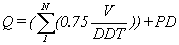
where:
Q is the flow rate to a grease interceptor in L/s.
V is the volume of the fixture in L.
DDT is the drain down time, 60 or 120 seconds
PD is any pump discharge in L/s.
N is the number of fixtures to go through the interceptor.
(9) All grease and oil interceptors shall have an internal flow control and where the head will exceed five feet, a secondary flow control shall be required.
(10) Floor drains that conform to Sentence 7.4.5.1.(3) are not required to be separately trapped and vented, and may be gang trapped when discharging through an oil interceptor.
Text · e-Laws consolidated snapshot
7.4.4.4. — Neutralizing and Dilution Tanks
(1) Where a fixture or equipment discharges corrosive or acid waste, it shall discharge into a neutralizing or diluting tank that is connected to the sanitary drainage system through,
(a) a trap, or
(b) indirect connection.
(2) Each neutralizing or diluting tank shall have a method for neutralizing the liquid.
Text · e-Laws consolidated snapshot
Provenance
OBC 1997 · continues from 7.4.4. — Pro
Base · O. Reg. 350/06 · ext← current
Original — base regulation
OBC 2012 · continues as 7.4.4. — Pro